I may earn a commission at no extra cost to you. #ad
The Essential Free Guide to Sensory Profiling and Consumer Taste Preferences
Jump to Section
Understanding Sensory Profiling
Sensory profiling is the scientific method used to evoke, measure, analyze, and interpret responses to products as perceived through the senses of sight, smell, touch, taste, and hearing. In the food and beverage industry, it is the backbone of R&D, allowing developers to create a "fingerprint" of a product's flavor, texture, and aroma.
Without accurate profiling, food manufacturers are essentially flying blind. A profile tells you not just that a product is "salty," but the specific intensity of that saltiness, how quickly it peaks, and how long it lingers on the palate. This objective data is crucial when trying to replicate a competitor's success or maintaining consistency across different manufacturing batches.
The Five Pillars of Taste
To profile a product accurately, one must understand the basic dimensions of taste. While "flavor" is a complex interaction of taste and retronasal aroma, "taste" specifically refers to what our tongue perceives:
- Sweet: Often associated with energy-rich carbohydrates.
- Sour: Can indicate acidity or fermentation; often used for brightness.
- Salty: Essential for electrolyte balance and a primary flavor enhancer.
- Bitter: Historically a warning for toxins, but in modern cuisine, it provides depth and balance (e.g., coffee, hops).
- Umami: The savory "fifth taste" triggered by glutamates, providing mouthfeel and satisfaction.
Sensory profiling maps these pillars to determine the "balance" of a product. For instance, a high-sugar beverage might require a specific level of acidity (sour) to prevent it from feeling cloying to the consumer.
Factors Influencing Consumer Preferences
Why do some people crave spicy food while others avoid it? Consumer taste preferences are not static; they are influenced by a complex web of biological and environmental factors.
Genetics: Some individuals are "supertasters" with a higher density of fungiform papillae, making them more sensitive to bitterness. Others may be "non-tasters" who require more intense seasoning to find a food palatable.
Culture and Geography: Preferences are often "learned." A consumer raised in Southeast Asia may have a higher preference for the fermented, funky notes of fish sauce compared to a consumer in Northern Europe. Sensory profiling must take the target demographic into account to ensure the product meets local expectations.
Age: Our taste buds diminish in sensitivity as we age. Products designed for seniors often require more robust flavor profiles to achieve the same level of satisfaction as products designed for children.
Modern Methods of Sensory Analysis
There are several professional techniques used to build a sensory profile. Each serves a different purpose in the product development lifecycle:
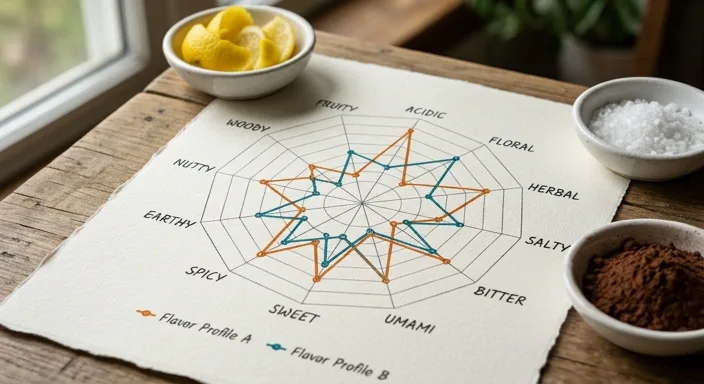
Quantitative Descriptive Analysis (QDA): This is the gold standard. A trained panel of 8–12 people identifies and quantifies the intensity of specific attributes. The result is often visualized as a "spider web" or radar chart.
Difference Testing: Used when a formulation changes (e.g., switching a supplier). The "Triangle Test" is common here, where a panelist is given three samples (two the same, one different) and must identify the odd one out.
Temporal Dominance of Sensations (TDS): This method tracks how flavors change over time while the product is being chewed or swallowed. It is particularly useful for chewing gum, chocolate, or complex sauces where the "finish" is as important as the first bite.
Bridging Data and Consumer Delight
The ultimate goal of sensory profiling is Preference Mapping. This involves taking the objective data from a trained panel and overlaying it with subjective "liking" scores from a large group of consumers.
By correlating these two datasets, developers can identify the "Ideal Point." For example, the sensory data might show that as "smokiness" increases, consumer liking increases—but only up to a point. Beyond that intensity, liking scores may drop off sharply. Finding this "sweet spot" is the difference between a market leader and a shelf-warmer.
In today's cost-conscious market, sensory profiling also helps in "value engineering." If a developer can identify that a specific expensive ingredient contributes to a sensory attribute that consumers don't actually prioritize, that ingredient can be reduced or replaced without damaging the product's market performance.