I may earn a commission at no extra cost to you. #ad
The Ultimate Free Guide to Umami Maximization in Plant-Based Formulations
Jump to Section
The Umami Gap in Plant-Based Protein
For decades, the primary challenge in plant-based product development was texture. However, as extrusion technology and mycelium-based proteins have matured, the focus has shifted toward flavor—specifically, the "craveability" factor. This craveability is driven almost entirely by umami.
Meat naturally contains high concentrations of free amino acids and nucleotides. When we remove animal proteins and replace them with pea, soy, or wheat gluten, we often lose that deep, lingering savoriness. Plant proteins, in their raw or isolated states, can often taste "flat," "beany," or "earthy." Closing this "Umami Gap" is the difference between a product that consumers buy once for health reasons and a product they buy repeatedly because they love the taste.
The Chemistry of Savory: Glutamates and Nucleotides
Umami is sensed through specific receptors on the tongue (T1R1 and T1R3) that respond primarily to L-glutamate. In plant-based formulation, we look for ingredients rich in these molecules. However, glutamates are only half the story.
There are two primary types of umami compounds:
- Amino Acids: Specifically L-Glutamic acid and L-Aspartic acid.
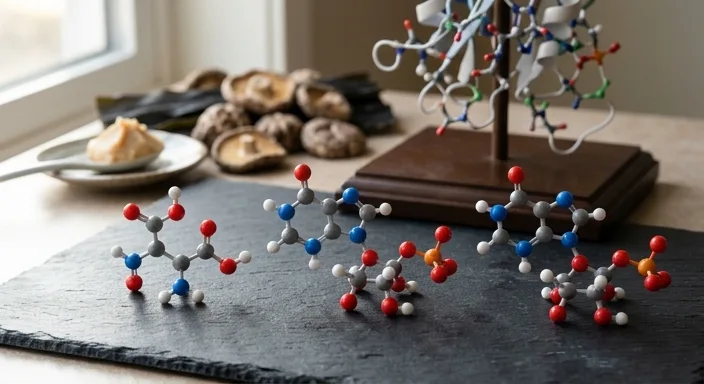
- Nucleotides: Specifically Inosine monophosphate (IMP) and Guanosine monophosphate (GMP).
While glutamates provide the "body" of the flavor, nucleotides act as "flavor potentiators." They don't just add their own flavor; they change the physical shape of the umami receptors on your tongue, making them more sensitive to glutamates. This is the biological foundation of umami maximization.
The Synergy Principle: 1+1=8
The most critical concept for any flavor chemist or food formulator is Umami Synergy. If you use an ingredient high in glutamate (like soy protein) and add an ingredient high in nucleotides (like shiitake mushroom extract), the resulting umami intensity is not additive—it is multiplicative.
Research shows that a 50:50 mix of glutamate and nucleotides can result in a flavor perception up to 8 times stronger than the same amount of glutamate used alone. In plant-based formulations, this allows for:
- Lower overall sodium levels (umami enhances the perception of salt).
- Reduced cost-in-use by using smaller amounts of expensive flavor extracts.
- Cleaner labels by avoiding heavy doses of synthetic flavorings.
The Plant-Based Umami Ingredient Toolkit
To achieve a meat-like profile without animal products, formulators must layer different sources of umami. Here are the most effective plant-derived tools:
1. Yeast Extracts: These are the gold standard for plant-based savory notes. Specific strains can be "tailored" to provide beefy, chicken-like, or even cheesy notes. They are naturally high in both glutamates and nucleotides.
2. Algae and Seaweed: Kombu (kelp) is the richest natural source of glutamates on the planet. Small amounts of kombu extract or dashi can provide a profound "bottom note" to plant-based seafood or broths without adding a "fishy" taste.
3. Fungi: Dried mushrooms, particularly Shiitake and Porcini, are incredibly high in GMP. Mushroom powders are excellent for "ground meat" applications, providing both umami and a dark, meat-like color.
4. Fermented Vegetables: Tomato paste, sun-dried tomatoes, and fermented black garlic are secret weapons. The process of ripening and drying concentrates natural glutamates significantly.
Fermentation as a Natural Flavor Multiplier
Fermentation is the ultimate tool for unlocking umami. During fermentation, enzymes (proteases) break down long, tasteless protein chains into short-chain peptides and free amino acids, including glutamate.
Incorporating fermented elements like Miso, Tempeh, or Traditional Soy Sauce into a formulation does more than add a specific flavor; it introduces a complex matrix of organic acids and esters that round out the sharp edges of plant proteins. For "clean label" demands, using "fermented pea protein" or "cultured dextrose" can provide the same flavor benefits while appearing more consumer-friendly on the ingredient deck.
Strategic Formulation: Beyond the "Meat" Taste
Maximizing umami isn't just about making things taste like steak. It's about providing the structural "mouthfeel" that plants often lack. Umami has been shown to increase salivation, which mimics the experience of eating juicy fat. This is particularly vital in low-fat plant-based applications.
When formulating, follow the Layering Technique:
- Base Layer: Use a high-glutamate source like hydrolyzed vegetable protein (HVP) or yeast extract to establish the savory foundation.
- Middle Layer: Introduce nucleotide-rich sources (mushroom or yeast-derived nucleotides) to trigger the synergy effect.
- Top Layer: Add aromatic volatiles via the Maillard reaction (searing/browning) to provide the "roasted" or "grilled" top notes that signal "meat" to the brain.
Frequently Asked Questions
Q: Does umami always mean high sodium?
A: No. In fact, umami allows you to reduce sodium. Because umami and saltiness enhance each other, you can typically reduce salt by 30-40% in a high-umami formulation without losing palatability.
Q: How do I mask the 'beany' off-notes in pea protein using umami?
A: Darker umami sources like roasted yeast extracts or fermented cocoa powder work best. These provide "masking by replacement," where the heavy savory notes occupy the sensory receptors, making the bitter/earthy notes less noticeable.
Q: Are there any plant-based umami sources that don't change the color of the product?
A: Yes. Light-colored yeast extracts and certain purified seaweed extracts provide high umami without the dark brown color associated with soy sauce or miso.